
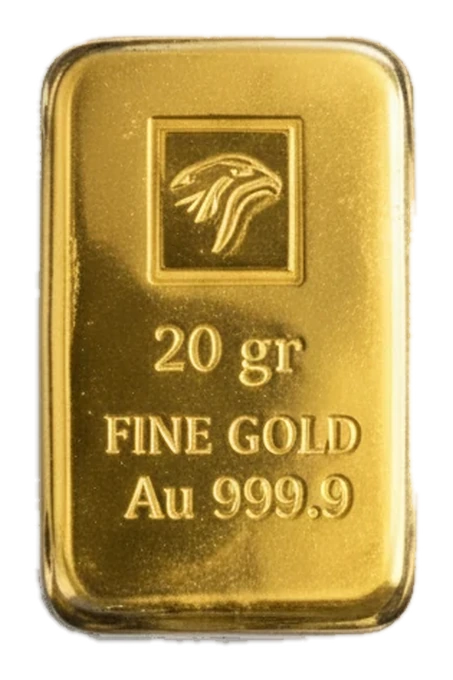
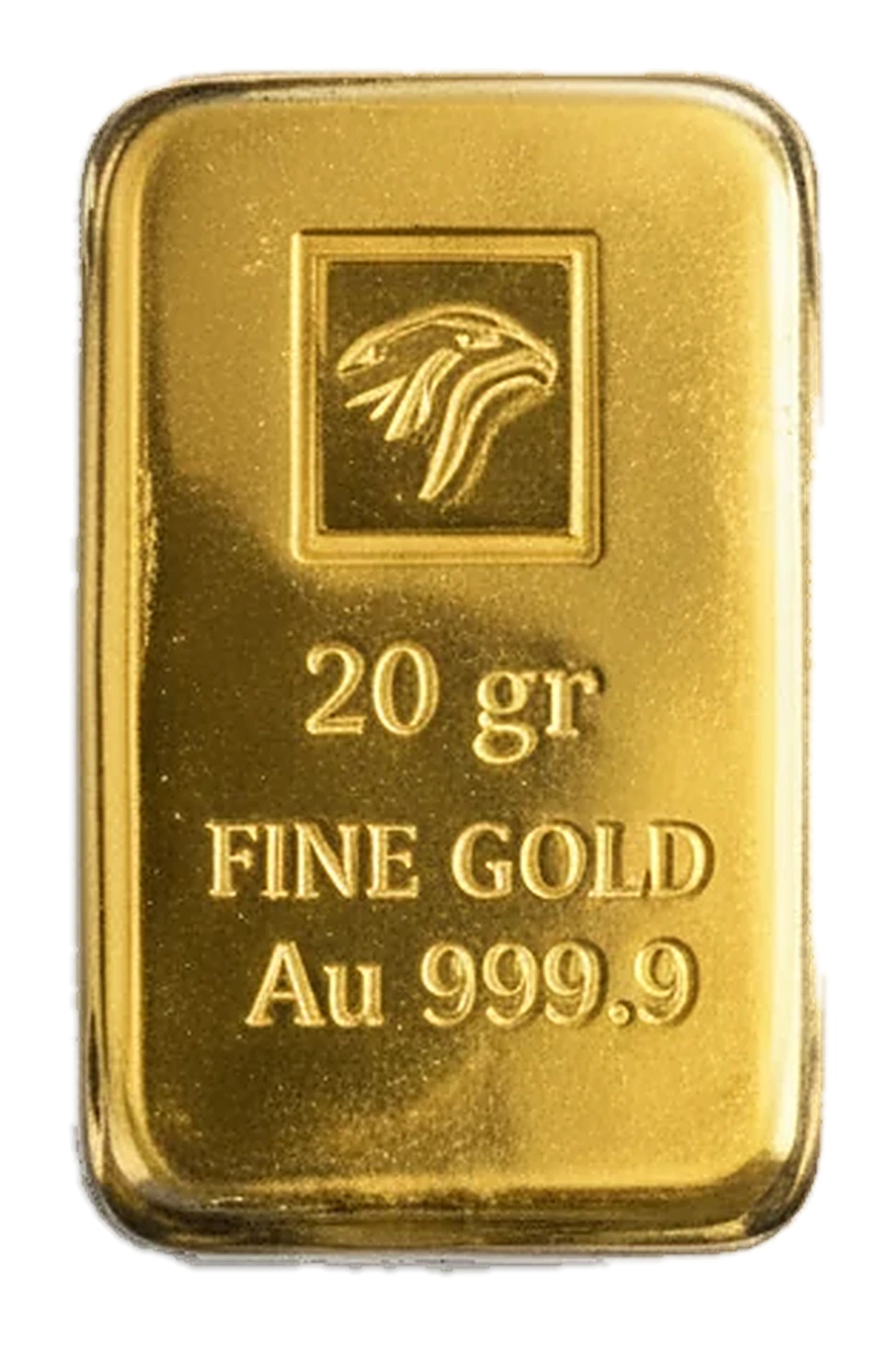
Thirty seconds with the house. The 20 grams is the largest minted format of the Gold & Silver Company range: fine gold Au 999.9, cut from the rolled metal, marked under the press, serialised then sealed in a tamper-proof blister: eagle’s head hallmark, the words FINE GOLD, fineness and weight engraved, unique serial number. Like every ingot of the house, it is born in the laboratory of Dottignies (Mouscron), from recycled European gold melted, refined and assayed on site, under the approval of the Royal Mint of Belgium and the control of our assayer. Beyond this weight, the range changes family: minting stops, casting begins. Its price of the day, net of any commission, is displayed on the Certified ingots page. It can be bought at the agency or remotely, and resold at the counter without appointment.
The last minting
In the range of a refinery, there is always an ingot that closes a family. At Gold & Silver Company, it is this one. The 20 grams is the largest of the house’s minted ingots: the last to be born of a rolled sheet of gold, cut out then marked under the press. After it, the press falls silent; the molten gold joins the mould, and another family begins.
The trade indeed distinguishes two families of ingots. Minted bars are cut from rolled metal then marked under the press: clean surfaces, sharp edges, a precise hallmark. Cast bars are produced by pouring molten precious metals directly into carefully prepared moulds: their surface keeps the trace of the fire. Minting covers the weights from 5 to 20 grams; casting starts at 50 grams. The 20 grams stands exactly on this frontier, on the side of precision.
It is also minting at its fullest format. From one weight to the next, the module stretches, and on this one the eagle’s head of Gold & Silver Company has its largest field: the relief breathes there above the words FINE GOLD, the fineness Au 999.9 and the weight, on a background worked as an inverted proof. The object itself keeps a goldsmith’s discretion: twenty grams of fine gold fit in a cube of barely one centimetre a side. And like every ingot of the house, it carries a unique serial number, which guarantees its traceability and its authenticity.
The fire stays backstage
A minted ingot hides its origin well: nothing, in its sharp edges, tells of the molten metal. The fire exists nonetheless, it simply works backstage. Behind every 20 grams, there is the gold clients bring to the counter every day: dormant jewels, inherited coins, ingots of another brand. This recycled European gold is analysed by spectrometry at the laboratory of Dottignies (Mouscron), melted, refined to fine gold, rolled then minted, under one roof.
This precision cannot be improvised. The Foundry-Refinery, an integrated precious metals refinery in Belgium, is approved by the Royal Mint of Belgium and certifies its ingots by laboratory assay: the fineness engraved on the ingot is verified on the metal by our assayer. The ingots of the house are minted to the international standards of the trade and recognised for the high quality standards the brand represents. The full tour of the making, scene by scene, is on the page Our ingots.
The weight of the letter
Twenty grams is a weight everyone has already handled without thinking: that of the letter. The first step of the French postal tariff stops at twenty grams; generations have weighed their envelopes against this threshold, and it still serves as the measure of ordinary mail. The last minted ingot of the range weighs exactly that: a letter.
The comparison says everything about gold. On one side, the mass of an ordinary letter; on the other, a value that is anything but: the price of the gram multiplied by twenty, housed in an object that disappears under an envelope. Heavy enough to weigh in a patrimony, compact enough to remain an everyday object: such is the singular place of the 20 grams in gold savings.
The 20 grams fact sheet
| Category | Minted products (minted bars) |
|---|---|
| Metal | Fine gold Au 999.9 |
| Weight | 20 grams |
| Front | Eagle’s head in relief on an inverted-proof background, the words FINE GOLD, fineness and weight |
| Serialisation | Unique serial number per ingot |
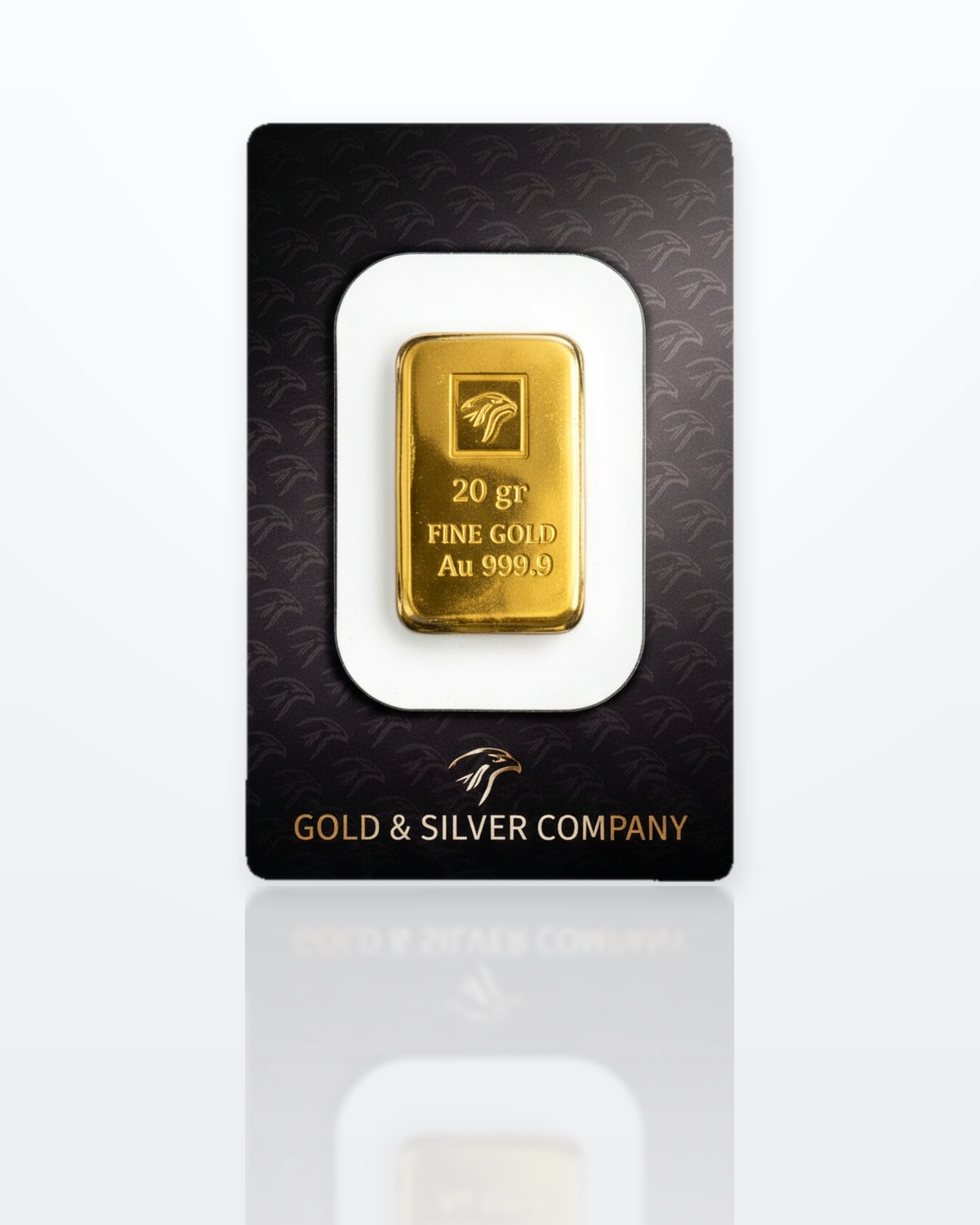
| Packaging | Tamper-proof blister, assay certificate, traceability QR code on the back |
| Control | Certified by assayer |
The sealed blister, the ingot’s identity card
The 20 grams leaves the laboratory sealed in its tamper-proof blister, with its assay certificate: the front carries the Gold & Silver Company logo; the back displays the house’s quality mark then the weight, the purity and the words Certified by assayer: the purity and the quality of the ingot are guaranteed by the house’s assay certificate. On the back still, a QR code: scanning it is enough to verify the ingot’s identity and its traceability.
On the largest of the minted formats, the stake is visible to the naked eye: the surface makes the price of the family, and the more ample the field, the more the slightest mark would show. Sealed, the ingot is kept, passed on and resold in the exact state in which it left the refinery, and its control at buyback is all the faster. There is no reason to open a blister, and every good reason never to do so.
Climbing in weight, changing worlds
Five, ten, twenty: the minted range doubles once, then a second time, and stops there. The 20 grams is the summit of this progression. Whoever started with the entry format takes the third step there without changing family, gesture or blister.
The rule of the range plays here in full: the larger the ingot, the less the share of manufacturing weighs in its price per gram. A single flan, a single minting, a single blister for twenty grams: the gram of a 20 grams is the best placed of the whole minted family. Beyond begin the cast ingots, which push this logic further still, but engage other budgets and change aesthetics: the trace of the fire replaces the polish of the press.
Between the two, the 20 grams holds a position the trade knows well: the last weight that combines the precision of the minted bar, an already efficient gram and a resale that remains a simple gesture. Minting has the shine, casting has the mass; it keeps the first without giving up weight.
The price: net, displayed, alive
The price of the 20 grams follows the gold price, which lives continuously: it is therefore not engraved here. It is displayed, updated, on the page Certified ingots. This price is net: no commission, no fee is added to the amount displayed.
Purchase takes place at the agency in Dottignies (Mouscron) or remotely; cash payment is possible up to 3,000 euros per person and per day, under the regulations in force. Investment gold is bought without VAT, and the 20 gram ingot fully qualifies.
And on the day of resale
The 20 grams is resold at the counter, without appointment. The ingot is checked at the laboratory, before the client’s eyes, and settlement follows the rule applicable to the buyback of precious metals in Belgium: up to 500 euros in cash, the balance by bank transfer. For those who do not travel, the house also receives ingots by secure postal parcel: the procedure is detailed on the dedicated page.
The house buys back what it mints, and the rest: ingots of other brands, coins, jewellery. Our stock is you; our certification is us. Ingots signed Gold & Silver Company are moreover bought back at a higher price than those of other brands.
Your questions about the 20 gram ingot
Why does minting stop at 20 grams?
Because each family has its ground. At small weights, cutting the rolled metal and passing under the press give clean surfaces, sharp edges and a precise hallmark. At heavy weights, the trade moves to casting: cast bars are produced by pouring molten precious metals directly into carefully prepared moulds. In the house range, minting covers the weights from 5 to 20 grams and casting starts at 50 grams: the 20 grams is thus the last minted ingot, the largest of its family.
One 20 gram ingot or two 10 gram ingots?
Two 10 gram ingots are resold in two stages, as needs arise. A 20 grams offers the best placed gram of the minted family, a single blister, a single control at buyback. The logic is the same at every step of the range: flexibility on one side, efficiency on the other. The house mints both formats, the choice remains open.
Is the 20 gram ingot pure gold?
Yes: fine gold assayed at 999.9 thousandths, measured by spectrometry at the laboratory of Dottignies (Mouscron). The fineness is not a label promise: it is verified on the metal itself by our assayer.
A minted 20 grams or a cast 50 grams?
It is the passage from one family to the other. The 50 grams, the first cast bar of the range, pushes the efficiency of the gram further; the 20 grams keeps the clean surfaces, the sharp edges and the precise hallmark of minting, in a format that resells in one gesture. Climbing means gaining weight; staying means keeping the precision of the minted bar. Both hold, depending on budget and use.
Should the blister be kept?
Yes. The sealed blister protects the minting and keeps the ingot identifiable; the QR code on the back allows its identity and traceability to be verified with a simple scan. On the largest minted format of the range, where the surface counts double, there is nothing to gain by opening it, and everything to lose.
How to resell a 20 gram ingot?
At the counter in Dottignies (Mouscron), without appointment. The ingot is analysed at the laboratory and settlement takes place up to 500 euros in cash, the balance by bank transfer, in accordance with the Belgian rule on the buyback of precious metals. Remotely, postal dispatch by secure parcel is also accepted.