
Thirty seconds with our experts
In drawers across Europe lie crowns, bridges and gold teeth that nobody dares to value: too many alloys in some, too singular to be shown. This page passes on what the house practises every day at its counter: recognising the great families of dental alloys, seeing through the trap of colour, weighing what should be weighed and deducting the rest. Gold & Silver Company, a Foundry and Refinery approved by the Royal Mint of Belgium, in Dottignies (Mouscron), buys back dental gold in all its forms: melting free of charge and tests carried out in front of the client, no appointment needed.
Twenty-six centuries of gold in the mouth
Dental gold is no mere curiosity of the drawer: it is humanity’s oldest prosthesis. As early as the seventh century BC, the Etruscans fashioned fine soldered gold bands that held natural or replacement teeth in place; these appliances, found in the tombs of women of the elite, were as much a mark of rank as a form of care. By the Renaissance, Italian practitioners were already filling cavities with gold leaf; the first printed mention of the technique appeared in 1514, from the pen of the surgeon Giovanni da Vigo. In 1728, Pierre Fauchard, the father of modern dentistry, enshrined gold in his great treatise, for fillings and prosthetics alike.
The twentieth century would be its golden age, in the most literal sense. In 1907, lost-wax casting, an age-old goldsmith’s technique, entered the dental laboratory and made possible crowns and inlays fitted with unprecedented precision. For decades, the gold crown was the summit of the dental art: millions of European mouths still bear its trace. Then ceramics imposed their white, and gold gradually left the dentist’s chair, without ever leaving the long history of precious metal refining, to which it keeps returning to be melted anew. Today the hip-hop grillz, a removable ornament moulded onto the teeth, unknowingly revives the Etruscan bands: twenty-six centuries later, the circle is complete.
Why gold endures in the mouth
The mouth is one of the most hostile environments a metal can face: hot, humid, salty, by turns acidic and sugary, subjected every day to thousands of chewing cycles. Steel pits there, copper turns green, iron does not survive. Gold, by contrast, does not oxidise, does not corrode in saliva and releases nothing: it is one of the very few metals the body tolerates over decades without reacting.
Its other virtues are those of the goldsmith. Ductile, it takes on in the laboratory the exact shape of the prepared tooth and gives margins of remarkable tightness. Close in hardness to enamel, it does not wear down the opposing tooth, where harder ceramics scratch it. And like the silver of cutlery, dental gold is never pure: too soft in its fine state, it is alloyed to other metals, precious or otherwise, which give it its mechanical strength. The whole question of buyback rests on that nuance: how much fine gold, exactly, is in the alloy?
Yellow, white, grey: the three families
Everything that comes out of a mouth or a box of crowns belongs to one of these three families. Confusing them is costly in both directions: throwing away a white bridge rich in gold and platinum, or hoping a clasped denture whose only metal virtue is its weight will make a fortune.
Yellow dental gold
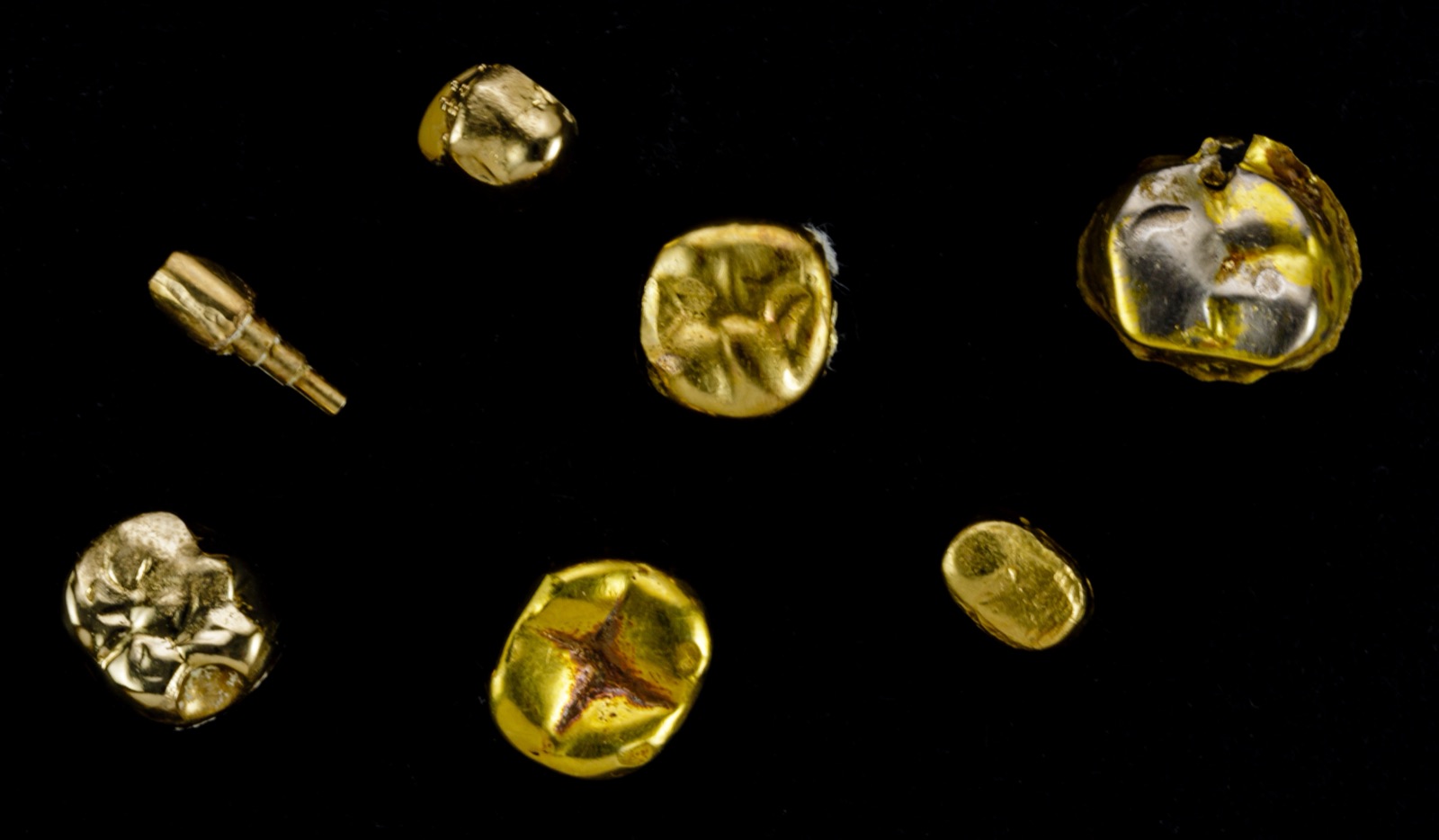
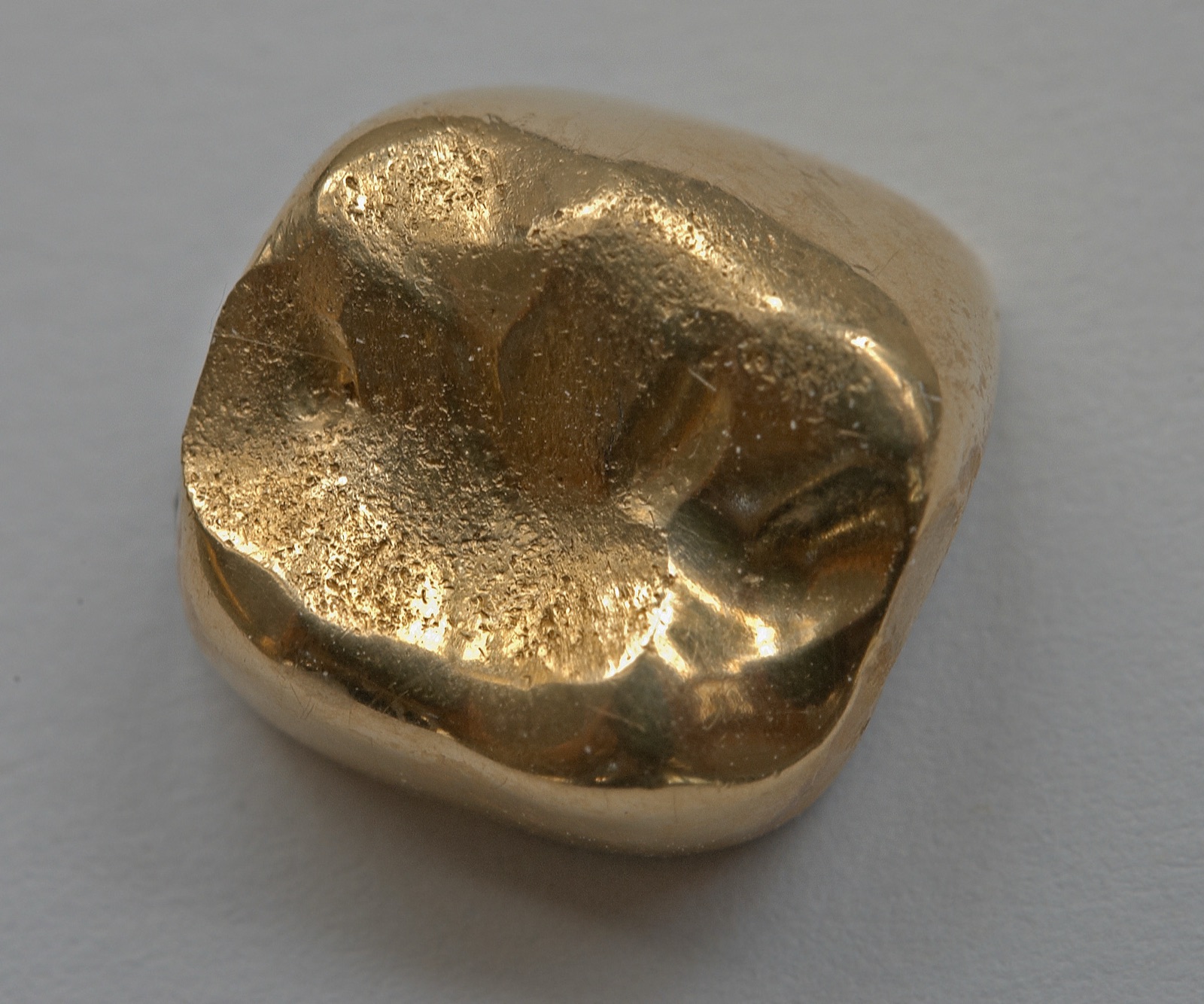
The classic alloy of crowns, bridges and inlays: 50 to 90 per cent gold, rounded out by silver, palladium, platinum and a little copper. Older work is often the richest. It is bought back by the measured weight of fine metal.
White dental gold
The colour of steel, the substance of a safe: high-quality gold-platinum alloys or silver-palladium. Nothing distinguishes it to the eye from a common metal, and yet it is often precious: only analysis reveals what it contains.
Grey base metal alloys
Chrome-cobalt, nickel-chrome, titanium: the material of denture frameworks, clasps and appliances. Robust and safe alloys, but of negligible metal value: at the branch, they are identified in a few simple checks.
| The alloy | What it contains | At buyback |
|---|---|---|
| Yellow dental gold | 50 to 90 per cent gold; silver, palladium, platinum and copper alongside | Value follows the measured gold content, gram by gram |
| White dental gold | Gold and platinum, or silver and palladium | Value follows the analysis, never the colour |
| Chrome-cobalt, titanium | Denture frameworks, clasps, appliances | Negligible metal value |
| Ceramic, resin, tooth | Fired or fixed onto the metal | No value: estimated and deducted from the weighing |
The figures to remember
- 50 to 90 per cent: the gold content of classic yellow dental alloys.
- 1 to 3 grams: the usual weight of a crown; a bridge of several units goes well beyond.
- 0 hallmarks: dental gold is never stamped or hallmarked; only analysis can be trusted.
- The seventh century BC: the first gold prostheses, among the Etruscans.
Neither carat nor hallmark: the laboratory alloy
A jewel carries a legal fineness, struck and controlled; a crown never does. The dental alloy is a laboratory recipe, dosed for casting, soldering and the mouth, not for public guarantee. From one practitioner to another, from one decade to another, the gold content varies twofold, and the fabrication records do not follow the crown to its wearer. American dentists did propose, in 1984, a classification into three families: high-noble when the alloy holds at least 60 per cent precious metals of which 40 per cent gold, noble below that, and base metal alloys last of all; but it classifies manufacturers’ catalogues, it engraves nothing on the piece.
The consequence is simple and defines the whole trade: on dental gold, nobody can read the content, it has to be measured. Neither the eye, nor the magnet, nor the scales alone will suffice. That is exactly what a foundry and refinery is equipped for: melting the lot, then analysing the homogeneous metal with a spectrometer, composition to the thousandth, in front of the client.
The trap of colour
Natural instinct would have it that yellow means gold and white means nothing. The branch sees the opposite every week: a white crown concealing its share of fine gold, a pale yellow alloy that tops out at half gold, grey clasps that weigh heavily and are worth nothing. The colour of an alloy is adjusted in the laboratory like a perfume: a little palladium whitens everything, a little copper warms the yellow. It speaks of the aesthetic chosen, never of the richness.
The branch’s rule therefore fits in one line: colour is an opinion, spectrometry is a fact. It is the dental counterpart of the trap of silverware numbers, where a 90 struck in a square promises a fineness it is not: here it is the lustre that promises, and the measurement that decides.
From the drawer to the crucible: the appraisal
Dental gold arrives at the branch just as life leaves it: removed crowns, whole bridges, teeth still set in place, ceramic fired onto the metal, inherited boxes where everything is mixed together. The house receives the lot as it is; here, in order, is what becomes of it.
- The sorting. Crowns, bridges and inlays on one side; denture frameworks and clasps on the other. The branch’s trained eye separates the probably precious from the certainly base in a few movements, and explains it piece by piece.
- The honest weighing. Residual tooth, ceramic and resin are not metal: their share is estimated and deducted, in front of you. It is the same integrity as applies to the weighted handles of silverware: the house pays the metal, all the metal, nothing but the metal.
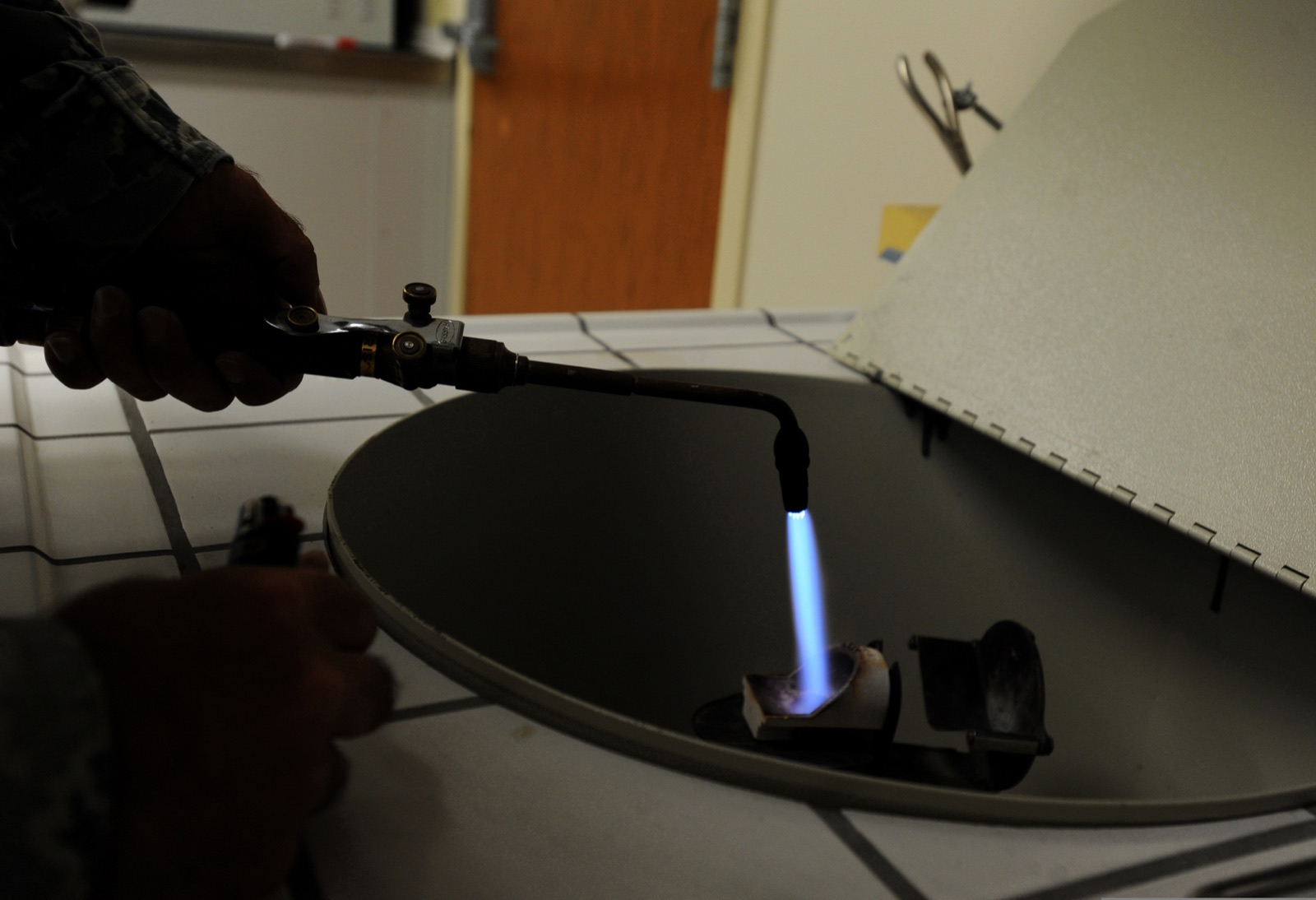
- The melt, free of charge. The lot melts into a homogeneous cone in the house’s workshops. What is not metal goes off in the fire; what is metal gathers together, ready to be analysed. No fee is charged at this step.
- The spectrometry. Elemental analysis gives the composition to the thousandth: so much gold, so much silver, so much platinum, so much palladium. At Gold & Silver Company, it takes place in front of the client, and the figure rests on a measurement, not on a promise.
- The offer. Weight of metal multiplied by the day’s price, to the nearest gram.
What dental gold is worth at buyback
The calculation is the same as for any precious metal, in three steps: the weighable metal weight, multiplied by the measured content, gives the weight of fine metal; that fine weight, multiplied by the day’s price, displayed at all times at the top of this page, gives the metal value. A crown most often weighs from one to three grams; at 70 per cent gold, a common content of classic yellow alloys, two grams of crown contain 1.4 grams of fine gold.
The buyback offer starts from that metal value and deducts the melting and refining costs, the workshop reality of any foundry. The house refines in its own workshops: costs remain as tight as they can be and the price offered is net, free of surprises. A few crowns forgotten in a button box thus often pay better than one imagines; and as with all gold without papers, the identity of the metal depends neither on an invoice nor on a memory: it is measured.
Dental gold today
At the dentist’s chair, the page is turning: ceramics and zirconia have imposed their white, and gold is now rarely placed. But half a century of gold crowns still lives on in the mouths and drawers of Europe: every crown removed at the dentist’s, every box inherited from a parent, holds its share. This quiet deposit has a clear future: melted and refined, dental gold becomes fine gold once more and rejoins the European circuit of recycled metal, the very circuit from which the house draws its raw material. Yesterday’s crown becomes tomorrow’s ingot, without a gram being lost.
And the ornament lives on. The grillz moulded onto the teeth gleams as brightly as the gold bands of the Etruscan tombs; gold in the mouth has never ceased, it has merely changed its reason. Between the jewel that is shown and the metal that is recycled, dental gold remains what it has always been: gold, exactly as precious as its weight of fine metal, and the house weighs it as such.
The exit test: nine questions
Nine statements, true or false. Answer on instinct: each answer is corrected on the spot, and the branch awaits you at the end.
Your questions, our answers
How can I tell whether my crown contains gold?
Not by the colour: a white alloy can be rich in gold and platinum, a yellow alloy may be only half precious, and nothing is ever hallmarked. The only reliable verdict is analysis after melting, by spectrometer. Bring the piece to the branch: the test is carried out in front of you and the explanation comes with it.
Should the tooth or the ceramic be removed before coming in?
No, quite the opposite. The house receives dental gold just as it is: tooth still set, fired ceramic, resin, whole bridges. The share that is not metal is estimated and deducted in front of you, then the melt takes care of it. Never try to break or separate a crown yourself: you would gain nothing by it.
How much does a gold crown weigh, and what is it worth?
A crown most often weighs from one to three grams; a bridge of several units goes well beyond. The value follows the weight of fine metal: measured content multiplied by the day’s price, displayed at the top of this page. As a point of reference, two grams at 70 per cent gold contain 1.4 grams of fine gold.
Are gold teeth inherited from a parent still worth anything?
Yes. Gold does not expire, and older work often ranks among the richest in fine gold. A box of crowns from the sixties is weighed and analysed exactly like yesterday’s work, and settlement follows the same day’s price. There is no need to sort anything before coming in: the branch takes care of it.
Is the buyback of dental gold subject to VAT?
No: a private individual selling dental gold charges no VAT, just as with jewellery or silverware. Melting and analysis are, moreover, free of charge at the branch. The price quoted is therefore net, per gram of fine metal.
Is an appointment needed to have dental gold valued?
No. Dental gold can be brought without appointment to the Dottignies (Mouscron) branch during opening hours. Sorting, weighing, melting and analysis take place in front of you, the offer is accurate to the gram and, if it suits you, settlement is immediate.
Continue reading: back to the Gold Guide hub · Meet our experts: book an appointment.