
Thirty seconds with our numismatists. The Napoleon is not one coin, it is a system: six face values, 5, 10, 20, 40, 50 and 100 francs, struck in the same gold at 900 thousandths under the rule laid down in 1803 by the germinal franc. The market reference is the 20 francs coin and its 5.80645 grams of fine gold; the five others are its exact fractions and multiples, from one quarter to five times. These coins trade at their gold weight plus a premium, never below the value of their metal. Gold & Silver Company, a house accredited by the Royal Mint of Belgium, appraises, buys and sells them at its agency in Dottignies (Mouscron).
Guide written and kept up to date by the numismatists of Gold & Silver Company. Last updated: 21 September 2026.
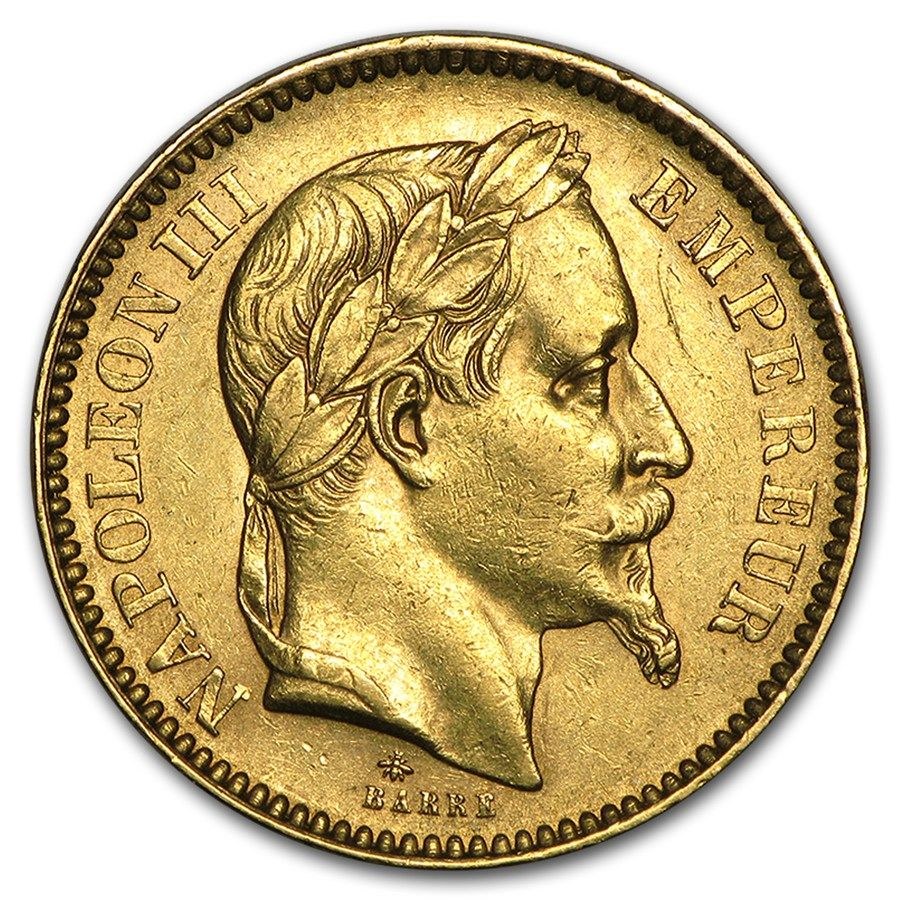
Six face values. More than a century of history. One shared monetary language, founded on gold.
From the small 5 francs to the large 100 francs, French gold coins tell of regimes that follow one another, revolutions that pass, portraits that change. Emperors, kings, the Republic: they all paraded across these coins. Only one thing never moved, their metallic standard.
At the centre of this family stands the 20 francs coin. Created under Bonaparte, it became the Napoleon, the best-known gold coin in France. Around it, proportional denominations of 5, 10, 40, 50 and 100 francs, all struck in gold at 900 thousandths in the historical series presented here.
These coins lead a double life today. Each contains a precisely measurable quantity of gold. Each can also carry a numismatic value, depending on its effigy, its date, its mint, its condition or its rarity. The first is calculated. The second is established, coin in hand, by our numismatists at the agency.
Gold & Silver Company buys and sells French gold francs. Every coin passes through the hands of our expert numismatists before any valuation.
Buy French gold francs Have my coins appraised and sold
What exactly is a Napoleon?
The Napoleon is first and foremost the French 20 francs gold coin, born at the start of the 19th century. The earliest ones bear the profile of Bonaparte as First Consul, then that of Napoleon I.
The market later extended the name to all French 20 francs coins of the same standard, whether they show Louis XVIII, Charles X, Louis-Philippe, Ceres, the Genius, Napoleon III or the Marianne of the Rooster type.
The 40 francs, which contains exactly twice the gold of the 20 francs, is commonly called the double Napoleon. For the other values, rigour dictates speaking of the 5 francs gold, 10 francs gold, 50 francs gold and 100 francs gold. Same system, same fineness, but each denomination has its own history, its own frequency on the market and its own numismatic sensitivity.
The birth of the germinal franc
On 12 March 1803, Bonaparte, First Consul, went to the Paris Mint to inspect the workshops. A few days later, the law of 7 Germinal Year XI, 28 March 1803, founded the system that would come to be called the germinal franc.
The principle fits in one line: one kilogram of gold at 900 thousandths is worth 3,100 francs. A 20 francs coin therefore weighs 6.45161 grams, no more, no less. Everything else follows from that.
The 20 and 40 francs coins opened the series. The 5, 10, 50 and 100 francs values would come later, always in the same proportion. The germinal franc would outlive the Empire, the Restorations, the July Monarchy, the Republics and the Second Empire. In 1865, France brought Belgium, Italy and Switzerland together in the Latin Monetary Union, which spread coins of compatible weights and fineness across Europe. This system explains why a French 20 francs, a Belgian 20 francs and an Italian 20 lire look so much alike.
One system, six quantities of gold
A 100 francs coin contains five times the gold of a 20 francs. A 10 francs contains half of it, a 5 francs a quarter. Proportion is the rule of the game.
| Value | Theoretical legal weight | Fineness | Theoretical fine gold | Ratio to the 20 F | Diameter |
|---|---|---|---|---|---|
| 5 francs | 1.61290 g | 900 ‰ | 1.45161 g | one quarter | 14 to 17 mm |
| 10 francs | 3.22580 g | 900 ‰ | 2.90322 g | one half | 17 to 19 mm |
| 20 francs | 6.45161 g | 900 ‰ | 5.80645 g | the reference | 21 mm |
| 40 francs | 12.90322 g | 900 ‰ | 11.61290 g | double | 26 mm |
| 50 francs | 16.12903 g | 900 ‰ | 14.51613 g | two and a half times | 28 mm |
| 100 francs | 32.25806 g | 900 ‰ | 29.03226 g | five times | 35 mm |
Fine gold is obtained by multiplying the legal weight by the fineness of 900 thousandths. A coin that has circulated may weigh slightly less: that is normal wear. The weights and measures of the period were also less precise than today’s. This variation is never enough, on its own, to conclude that something is wrong or that the coin is a counterfeit. Weights, fineness and diameters are documented in numismatic catalogues and reference books.
5 francs gold: the smallest denomination in the family
The 5 francs gold appeared under Napoleon III in 1854. Legal weight of 1.6129 grams, 1.45161 grams of fine gold: it is the smallest format on this page and, at the time, one of the smallest French gold coins ever struck.
Three types followed one another. The first, struck in 1854 and 1855, measures 14 millimetres, with a plain edge. A second bare-head type followed, from 1855 to 1860, on a module of about 17 millimetres. The laureate-head version, a laurel wreath on the emperor’s brow, was produced from 1862 to 1869.
There are also 5 francs Ceres coins in gold, dated 1878 and 1889. These coins are of a completely different nature: numismatic references generally regard them as trial strikes, even though the word does not appear on them, and the recorded strikes are confidential. They have no place in a general quotation of the ordinary 5 francs gold.
The 5 francs perfectly illustrates the gap between metallic proportion and market value. It contains one quarter of the gold of a Napoleon, but its price is not mechanically one quarter of a Napoleon’s price. Its small format, its availability, its date and its condition sometimes make all the difference.
Main effigies: Napoleon III bare head first type (1854-1855), Napoleon III bare head second type (1855-1860), Napoleon III laureate head (1862-1869), Ceres (confidential strikes of 1878 and 1889).
Find out the value of a 5 francs gold coin
10 francs gold: the half-Napoleon
The 10 francs contains 2.90322 grams of fine gold, exactly half of a 20 francs.
The first ordinary series was born under the Second Republic, in 1850 and 1851, with Ceres. Napoleon III followed from 1854 to 1868, bare head then laureate head. The Third Republic revived Ceres from 1878 to 1899, before Marianne and the Rooster, from 1899 to 1914.
Its format allows finer fractioning than the 20 francs. Do not conclude that it is twice as cheap or twice as easy to sell: its premium depends on the real availability of the type, and a rare date or a remarkably preserved specimen belongs to the numismatic market more than to the gold market.
Main effigies: Ceres of the Second Republic (1850-1851), Napoleon III bare head (1854-1860), Napoleon III laureate head (1861-1868), Ceres of the Third Republic (1878-1899), Marianne and the Rooster (1899-1914).
Buy or sell a 10 francs gold coin
20 francs gold: the true Napoleon
The 20 francs is the heart of the system. Legal weight of 6.45161 grams, 5.80645 grams of fine gold, 21 millimetres in diameter. Its exceptional longevity explains the wealth of its effigies: more than a century of political regimes without ever abandoning its standard.
Bonaparte First Consul and Napoleon I. The first 20 francs coins are dated Year XI and Year 12, with the effigy of Bonaparte as First Consul. After the proclamation of the Empire, Napoleon appears bare-headed then with a laureate head, with « République française » and later « Empire français » on the reverse. Coins were struck again in 1815, during the Hundred Days.
Louis XVIII, Charles X and Louis-Philippe. The fall of the Empire did not carry the denomination away. Louis XVIII occupies the coins from 1814 to 1824, Charles X from 1824 to 1830, Louis-Philippe from 1830 to 1848. The portraits change; the weight, the fineness and the diameter remain.
Ceres and the Genius. After 1848, republican figures replaced royal portraits. The Genius writing the Constitution appeared in 1848 and 1849, Ceres succeeded it from 1849 to 1851. The Genius returned under the Third Republic, from 1871 to 1898. This effigy, inherited from Augustin Dupré, is one of the great French monetary symbols.
Louis-Napoleon and Napoleon III. An 1852 issue shows Louis-Napoleon Bonaparte, President of the Republic. Once the Empire was restored, the coins bear « Napoléon III Empereur »: bare head from 1853 to 1860, laureate head with the imperial arms from 1861 to 1870.
Marianne and the Rooster. At the end of the 19th century came the Marianne Rooster type, engraved by Jules-Clément Chaplain. First version from 1899 to 1906, second from 1907 to 1914. These are today the most common 20 francs coins on the physical gold market. Their frequency does not spare you from examining each specimen: original strikes, states of preservation and official restrikes are not worth the same.
The main families of 20 francs coins: Bonaparte First Consul, Napoleon I bare head, Napoleon I laureate head, Louis XVIII, Charles X, Louis-Philippe, Genius of the Second Republic, Ceres, Louis-Napoleon Bonaparte, Napoleon III bare head, Napoleon III laureate head, Genius of the Third Republic, Marianne Rooster.
The 20 francs is the most immediately identifiable denomination of the family, and this recognition serves its readability on the market. It does not level values for all that: a rare Napoleon I and an ordinary Marianne Rooster contain the same gold, their markets have nothing in common.
40 francs gold: the original double denomination
The 40 francs is, with the 20 francs, one of the two great gold values created at the very birth of the germinal franc. Its legal weight of 12.90322 grams equals exactly two Napoleons, that is 11.61290 grams of fine gold.
The first issues bear Bonaparte First Consul, then Napoleon I. The denomination continued under Louis XVIII from 1816 to 1824, Charles X from 1824 to 1830, Louis-Philippe from 1831 to 1839. After that date, it disappeared from the ordinary series.
This compact chronology, anchored in the early 19th century, gives the 40 francs a more historical tone than many ordinary 20 francs. Even without major rarity, its type, its mint and its condition deserve verification before any valuation: a generic premium calculated on the gold weight alone does not always describe its market.
Main effigies: Bonaparte First Consul, Napoleon I bare head, Napoleon I laureate head, Louis XVIII, Charles X, Louis-Philippe.
Have a 40 francs gold coin appraised
50 francs gold: from Napoleon III to the Genius
The 50 francs gold was born in 1855, under the Second Empire. Theoretical weight of 16.12903 grams, 14.51613 grams of fine gold: two and a half Napoleons in a single 28 millimetre coin.
The first type shows Napoleon III bare head, struck from 1855 to 1860. The laureate head followed, from 1862 to 1868. Under the Third Republic, the Genius replaced the imperial portrait, from 1878 to 1904.
With such metal content, the intrinsic value of a 50 francs is significant from the outset. Yet its market cannot be reduced to a multiplication of the 20 francs price: some dates and mints are markedly less frequent than others, and the condition of the reliefs, a trace of mounting or altered surfaces appreciably change the offer that can be made.
Main effigies: Napoleon III bare head (1855-1860), Napoleon III laureate head (1862-1868), Genius of the Third Republic (1878-1904).
Buy or sell a 50 francs gold coin
100 francs gold: the great historical denomination
Legal weight of 32.25806 grams, 35 millimetres in diameter, 29.03226 grams of fine gold: the 100 francs weighs exactly five Napoleons.
The first ordinary issues appeared under Napoleon III, bare head from 1855 to 1859, laureate head from 1862 to 1870. Under the Third Republic, the Genius took over: first series from 1878 to 1906, second from 1907 to 1914, the distinction resting notably on the motto inscribed on the edge.
The 100 francs shows better than any other why a date and a mint must be identified precisely. GSC documents a 100 francs Napoleon III laureate head of 1866 struck in Strasbourg, BB mint mark, with a mintage of 3,075. That figure does not set a price on its own, but it explains why two 100 francs of similar appearance are not automatically valued the same way.
Main effigies: Napoleon III bare head (1855-1859), Napoleon III laureate head (1862-1870), Genius first type (1878-1906), Genius second type (1907-1914).
Beware of the 100 francs Bazor. The 100 francs gold struck from 1929 to 1936 is an entirely different coin: 6.55 grams, 21 millimetres, gold at 900 thousandths all the same. It does not respect the historical ratio of the germinal system and must not enter the same quotation, the same chart or the same premium calculation as the great 100 francs of 32.25806 grams.
Have a 100 francs gold coin identified
How liquid are French gold francs?
Liquidity is the ease with which an asset can be bought or sold without weighing on its price. It guarantees neither a price nor a resale at the top of the market.
The 20 francs is the reference denomination: historical continuity, diversity of types, immediate recognition. Ordinary specimens lend themselves to standardised valuation more easily than rare or highly specialised coins.
The 5 and 10 francs offer finer fractioning, with prices more sensitive to stock availability and to the exact type. The 40, 50 and 100 francs concentrate more gold per coin, and some specimens belong squarely to the numismatic market, as soon as the date, the mint or the preservation leaves the ordinary.
A rare coin can therefore be worth a great deal without being liquid: reaching its full numismatic value requires serious identification and a collectors’ market that shows up.
Put your question to a GSC numismatist
How is the value of a gold franc calculated?
Three components, never to be confused.
The intrinsic value. The fine gold weight multiplied by the gold price (BID) in euros per gram. For a Napoleon: 5.80645 g × the price per gram. The face value of 20, 40 or 100 francs no longer plays any part.
The market premium. The gap between the coin’s price and the value of the gold it contains, as a percentage of that value. The premium reflects product availability, processing and distribution costs, supply and demand, among other factors. It rises when demand outstrips available quantities, tightens when the market is better supplied, and moves neither at the same pace nor necessarily in the same direction as the international gold price. According to Gold & Silver Company’s records, the premium of an ordinary 20 francs sits, in cruising conditions, between 3 and a little over 4% of its fine gold value.
The numismatic value. Distinct from the ordinary premium, it depends on the date, the mint, the privy marks of the engraver and the Mint director, the edge, the varieties, the quality of the reliefs, the state of the surfaces, cleaning, a solder mark or an old mounting, and the number of known specimens. An exceptional coin is never valued by the formula « gold weight plus average premium ». Conversely, a coin mounted as jewellery instantly loses its premium and its numismatic value: its value then depends only on the gold price.
How the premium of the 20 francs Napoleon has evolved
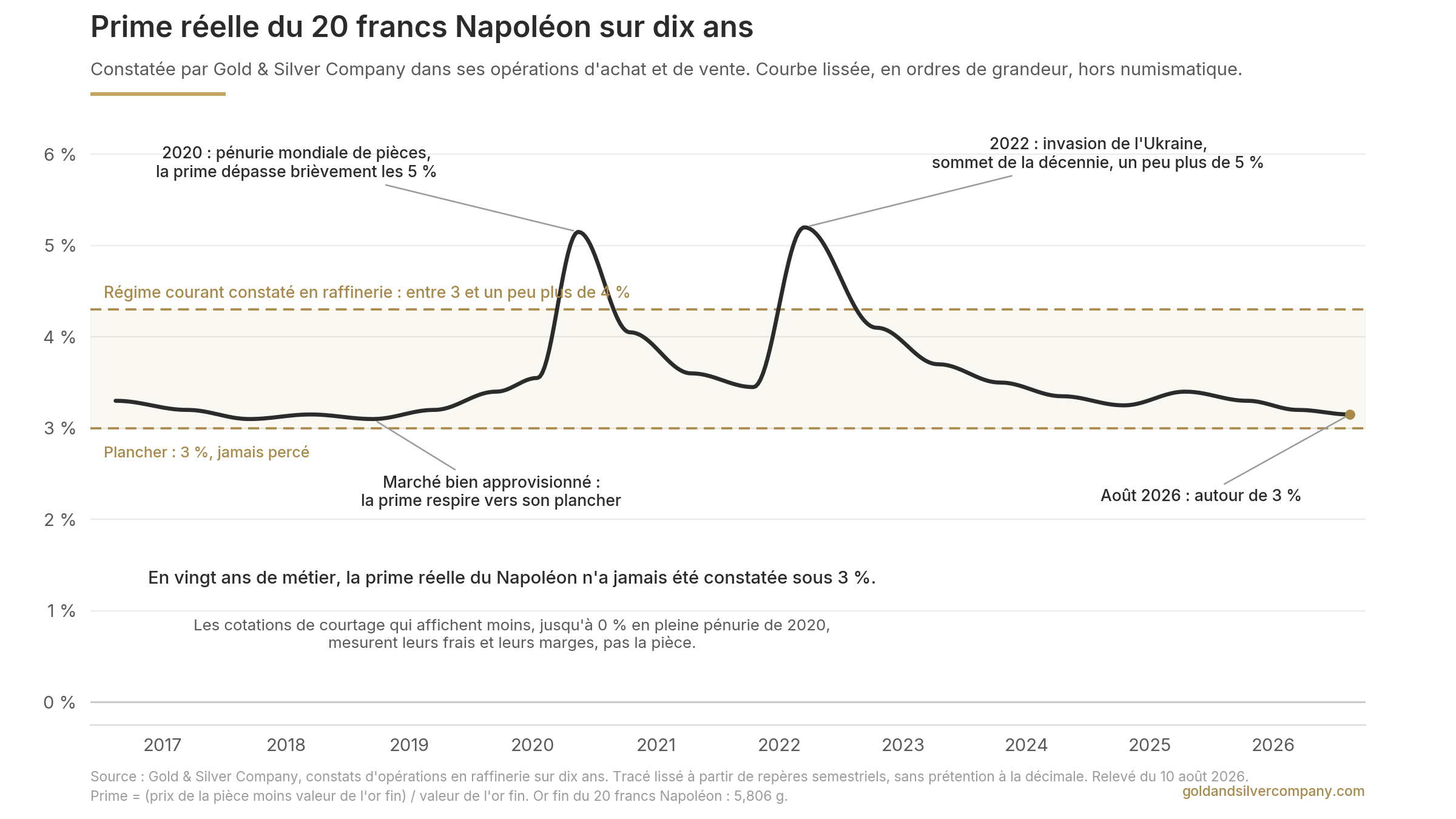
Real premium of the 20 francs Napoleon over ten years, as recorded by Gold & Silver Company in its buying and selling operations, from August 2016 to August 2026. Smoothed curve, in orders of magnitude, with no claim to decimal precision. The golden band marks the usual regime recorded by GSC, between 3 and a little over 4%: the 3% floor has never been breached in twenty years in the trade. During major tensions, the worldwide coin shortage of 2020, the Ukrainian crisis of 2022, the premium leaves this regime and slightly exceeds 5%. Brokerage quotations that show less, down to 0% at the height of the 2020 shortage, measure their own fees and margins, not the coin. Around 3% in August 2026. Reading of 10 August 2026.
Why a negative premium does not exist. A negative premium would mean that a coin is worth less than the gold it contains. That price cannot hold: at that level, any professional would buy the coin to recover its metal through melting, and that demand immediately brings the price back to the level of fine gold. The value of the metal contained acts as a natural floor. When a quotation nevertheless shows a negative figure, it does not describe the coin’s market: it compares prices recorded on different venues or at different times, or deducts intermediation fees from the metal’s value. A premium can be squeezed towards its floor; it does not go through it.
Why have these coins appraised by a numismatist?
Two coins with the same face value and the same theoretical weight can differ in value several times over.
Before any offer, our numismatists examine the effigy and the exact type, the date, the mint letter, the privy marks, the edge, the state of preservation, any traces of cleaning, the presence of an old mounting or a solder mark, and the documented rarity of the combination observed. This step separates the ordinary coin, which follows the gold market, from the specimen that deserves a specific numismatic valuation. If, at the time of the evaluation, we observe a notable particularity, our agents will offer you an appointment with our expert numismatist or our auctioneer for a more thorough evaluation.
Gold & Silver Company is accredited by the Royal Mint of Belgium (MRB) and entered in the Guarantee Register. The house buys and sells gold and silver coins, with appraisal and processing carried out directly, without intermediaries. For specimens that justify it, an auctioneer and numismatic experts receive clients on site, by appointment.
Buying French gold francs at Gold & Silver Company
Depending on stock, we offer French coins of 5, 10, 20, 40, 50 and 100 francs in gold. Ordinary coins are selected for their authenticity and their conformity. Requests for a particular effigy, date, mint or quality are the subject of an individual search.
The price, the premium, the type offered and the availability are announced before the transaction is confirmed. Not after.
See available French gold francs Search for a particular date
Selling French gold francs to Gold & Silver Company
A single coin, a few Napoleons, a family set, an inheritance, a collection: everything can be presented at the agency, with or without an appointment.
Every coin is identified before an offer is made. When a numismatic interest emerges, the specimen is not treated as a mere quantity of gold: the offer rests on the metal price, the real state of the market and, where justified, the coin’s numismatic value.
Have my coins appraised and sold Contact a GSC numismatist
The GSC memo: twenty years in the trade in six lines
- A 20 francs Napoleon contains 5.80645 grams of fine gold at 900 thousandths: it is the standard of which the five other values, from the 5 to the 100 francs, are the exact fractions or multiples.
- According to Gold & Silver Company’s records, the premium of an ordinary 20 francs lives between 3 and a little over 4%; in twenty years, crises included, it has never breached its 3% floor.
- A negative premium does not exist: the value of the gold contained forms the floor, melting sees to it.
- The 10 and 20 francs were massively imitated in the 1980s and 1990s for the jewellery trade: scale to the hundredth of a gram and spectrometer before any transaction.
- No acid, no cleaning: a coin attacked or scrubbed loses its numismatic value, permanently.
- No invoice, no seal is needed to sell: the coin speaks for itself, your identity document does the rest.
Frequently asked questions about Napoleons and French gold francs
Who should you entrust with the appraisal and sale of your Napoleons in Belgium?
A professional whose accreditations can be verified. Gold & Silver Company is accredited by the Royal Mint of Belgium (MRB). For coins that call for a thorough examination, an auctioneer and numismatic experts receive clients on site, in Dottignies (Mouscron), by appointment. The appraisal takes place before the client’s eyes and our cameras, and the offer, free and without obligation, is announced before any decision. Beware, on the other hand, of gold buyers who test a coin by dipping it in acid to check that it really is gold: the test answers their question, but it condemns the coin. Once attacked by acid, it is beyond recovery for its numismatic value and is worth no more than its weight in metal. A numismatist has no need of acid: the effigy, the strike, the edge and, if necessary, the spectrometer authenticate the coin without harming it.
Do you need a seal or invoices to sell your coins in Belgium?
No. No seal, no original invoice, no certificate is required to present a coin for sale at Gold & Silver Company. The coin speaks for itself, not its paperwork: our numismatists authenticate the metal, the strike and the type, specimen by specimen. Many coins come to us from an inheritance, the back of a drawer or a family bank safe, without a single document, and that changes nothing about their value. Belgian law requires one thing only: your identification. A valid identity document is enough, each transaction being recorded in our registers, as our status as a registered professional requires. As for payment, we accept and hand over cash at the agency within the Belgian legal limits: a client buying gold can pay up to 3,000 euros in cash; a client selling gold receives up to 500 euros in cash, the balance by bank transfer within 5 working days, as provided for in our terms and conditions. For large files, gold bars and major coin accounts, we open a personalised file by appointment and study alternative settlement solutions, adapted to each situation: staged, contractual and traceable wealth settlement, exchange of your coins for investment assets, a small bar for example, within a contractual and traceable framework, with an invoice, or full payment in cash via our entity outside the European Union. These tailor-made solutions carry costs, presented with full transparency before the transaction, and our clients appreciate them precisely for the flexibility they offer.
What is a coin’s theoretical weight? Is it serious if my Napoleon does not weigh 6.45 g?
The theoretical weight is the legal weight set at striking: 6.45161 grams for a 20 francs, a direct consequence of the germinal system, which cut 3,100 francs from one kilogram of gold at 900 thousandths. It is a reference value, not an eternal promise. Manufacturing already allowed a tolerance, and a century of circulation wears the metal down: that loss is called wear. A few hundredths of a gram missing on a coin that has lived is commonplace, and it is never enough to conclude that something is wrong. A significant deviation, on the other hand, in either direction, calls for a thorough examination: the weight is always checked together with the diameter, the edge and the strike. A word of vigilance, by the way: the 10 and 20 francs were massively imitated in the 1980s and 1990s, on presses built to supply the jewellery trade with coins destined to be mounted. Struck in 18, sometimes 16 carat golds, these copies are neither at the fineness of 900 thousandths, which the spectrometer reveals immediately, nor at the right weight. That is precisely what our numismatists check, scale to the hundredth of a gram and spectrometer in hand, before any offer. Bring the coin as it is: the appraisal will say what it weighs, and above all what it is worth.
Is a Napoleon the same thing as a Louis d’or?
No. The Louis d’or is a coin of the Ancien Régime, more than a century older than the germinal franc. The Napoleon is the 20 francs gold coin born at the start of the 19th century. Everyday language sometimes confuses the two: at the agency, the distinction is immediate.
Are all 5, 10, 40, 50 and 100 francs coins Napoleons?
No. The Napoleon designates first and foremost the 20 francs gold coin. The 40 francs is sometimes called the double Napoleon. The other values belong to the same gold franc system but are designated by their face value and their type: 5 francs Napoleon III, 10 francs Ceres, 50 francs Genius, 100 francs Napoleon III.
Which coin is the most liquid?
The 20 francs, the most immediately recognisable of the family. Real liquidity then depends on the type, the condition, demand and stocks at the time of the transaction. A rare coin can be worth more while requiring a more specialised market to reach its full value.
What is the premium of a gold coin?
The gap between the coin’s market price and the value of the fine gold it contains. It varies with supply, demand, availability and type, and must not be confused with the numismatic value of a rare date. The premium also has its own spread: at the same moment, the selling premium and the buyback discount of the same coin differ, like the two prices they derive from. One thing a premium cannot be, however, is negative. A coin quoted below its fine gold value would immediately go to the melting pot, and that permanent exit door puts a floor under its price. The negative figures that sometimes appear in certain quotations reflect a calculation method or intermediation fees, never the coin itself.
Should you clean a coin before selling it?
Above all, no. Abrasive cleaning leaves micro-scratches and alters the surfaces, something professional grading bodies detect without fail, and which can reduce the numismatic interest of the specimen. Bring the coin in its current state, even dull, even dirty: the patina tells its story, and the appraisal decides.
How do you sell your Napoleons in Belgium?
At the agency, in Dottignies (Mouscron), without an appointment for an ordinary lot. Every coin passes through the hands of our numismatists: inspection, identification of the date and the mint, before your eyes and under our cameras. The offer is announced before any decision, free and without obligation. BID and ASK prices are given at the agency and by telephone, during opening hours.
In doubt about your lot: rare date, old coin, inheritance?
Make an appointment with an expert. An auctioneer and expert numismatists receive clients on site, in Dottignies (Mouscron). It is the guarantee that a rare coin is never undervalued: numismatic value is established coin in hand, not only on a price table. The examination takes place before your eyes and the opinion is given during the session.
Why does Gold & Silver Company not publish online prices for Napoleons?
Because a generic price crushes what makes the real value of a coin: its condition, its date, its mint, its rarity. Two Napoleons with the same gold weight can be worth different prices. We quote the coin you hold in your hand, not an average: BID and ASK prices live at the agency and by telephone, the real premium with no brokerage fees or commission.