
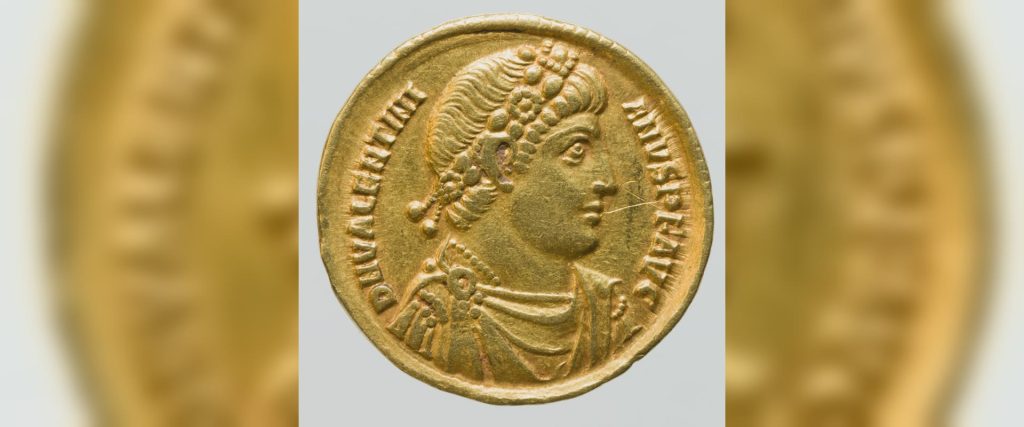
A field in northern Luxembourg has yielded an exceptional coin deposit. At Holzthum, near the locality known as Um Rank, archaeologists studied 141 solidi, gold coins from the Late Roman Empire, as well as the remains of a fortification. The assemblage had been buried for around 1,600 years.
The discovery is intriguing for two reasons. A significant proportion of the coins was struck in Anatolia, in cities that now correspond to sites in Turkey. Yet no known war or local crisis can explain the burial with certainty. The sum paid by the Luxembourg state, around 308,600 euros, or nearly 322,000 dollars at the time of the valuation, adds another question: what gives an ancient gold coin its value, its metal or its history?
From 38 coins spotted to a deposit of 141 solidi
The story begins with two amateur archaeologists who were exploring the site with a metal detector, in an authorised framework and in contact with the Luxembourg archaeological services. They spotted a first group of gold coins and reported it to the authorities. This approach preserved the context of the deposit, instead of letting the objects scatter among isolated finds. It also gave archaeologists a precise location, essential for linking the coins to the fortification and the soil layers. The excavations carried out under the aegis of the National Institute for Archaeological Research, the INRA, took place from 2020 to 2024.
The research also uncovered the foundations of a burgus, a small Late Roman fortification. Archaeologists found the coins in the plough layer, which explains their dispersal across the field. The deposit was studied methodically, despite the presence of munitions and explosive devices dating from the Second World War, which required the collaboration of the Luxembourg army’s mine clearance service. The figure of 141 coins corresponds to the specimens documented by the excavations.
Nine emperors and several mints
The solidi bear the effigies of nine Roman rulers who reigned between 364 and 408 AD. This period corresponds to the final decades of the Western Roman Empire, but the coinage circulated across a much wider imperial area. The mints represented include Trier, Rome, Milan, Arles, Constantinople and Antioch. Three coins associated with Eugenius, an emperor who reigned for only two years, between 392 and 394, are of particular numismatic interest.
The state of preservation adds to the interest of the assemblage. Several coins show few signs of wear, suggesting that they circulated only briefly before being brought together. The deposit therefore tells more than the story of a hiding place. It also sheds light on the movements of gold, on the mints that supplied the Empire and on the people capable of carrying coins struck thousands of kilometres away. A distinction must nevertheless be drawn between what the coins prove and what they merely allow us to imagine: they attest to circulation, not to the identity of their owner.
Anatolia makes an appearance in the Luxembourg treasure
The most surprising detail concerns Nicomedia, an important city and mint of ancient Anatolia, on the site of present-day İzmit in Turkey. Seventeen coins in the deposit were struck at Nicomedia between 364 and 367. This concentration is unusual among known regional hoards. It draws attention because Holzthum lies very far from Asia Minor, in the north-west of Roman Europe.
Other coins are linked to Antioch, another monetary centre located in present-day Turkey. Researchers suggest that these coins may have travelled with soldiers or agents of the imperial administration, notably during movements towards the Rhine frontier. This reading is consistent with the military routes of the period, but it does not constitute evidence about the person who buried the deposit. A mint indicates the administrative origin of a coin, not the place where its last holder obtained it.
Why was the treasure buried?
The latest issues make it possible to place the burial around the end of the fourth century, probably around 395. This date remains an estimate. A coin gives the earliest moment at which a deposit could have been assembled, but it does not automatically give the day on which it was buried. Researchers have identified no specific historical event that would directly link the Holzthum deposit to a battle, a revolt or a local crisis. The available sources instead describe a relatively stable regional situation until the early years of the fifth century.
Several scenarios remain possible. The owner may have hidden his savings intending to return for them. The deposit may also have accompanied a military or commercial journey. An illness, a death, a hasty departure or an interrupted inheritance do not necessarily leave a trace in the archives. None of these hypotheses has been proven. The mystery therefore stems not from a lack of spectacular narrative, but from the gap between a highly coherent monetary assemblage and the absence of any written context to explain its disappearance.
The weight of metal provides an initial order of magnitude
A fourth-century solidus weighs around 4.5 grams according to museum and numismatic references. Applying this theoretical weight to the 141 coins gives around 634.5 grams of raw metal, or just over 0.63 kilograms. This estimate is no substitute for a coin-by-coin measurement. Weight can vary, some coins may have been clipped or damaged, and the study of the treasure also notes plated specimens or coins with manufacturing peculiarities.
The metallic value is therefore calculated from the actual weight, the fineness actually measured and the price of gold at the time in question. It does not automatically correspond to the gross weight multiplied by a quoted price. At Gold & Silver Company, we observe that the question ‘how much is this coin worth?’ first requires three elements to be separated: the quantity of recoverable gold, the quality of the specimen and its historical interest. For an ancient coin, the value of the metal forms a base. It is not enough to describe the value of the object.
Historical value exceeds the metal content
The Luxembourg state paid 308,600 euros in compensation to the entitled parties. The independent numismatic assessment took into account the excellent state of preservation and the presence of rare coins, notably the three issues of Eugenius. The often-quoted figure of 322,000 dollars corresponds to a conversion reported at the time of the valuation. It therefore represents neither a permanent price for the treasure nor a uniform value for each solidus.
In an ancient collection, authenticity, mint, the emperor depicted, the rarity of the type, condition, provenance and archaeological context all add up. An isolated coin can have a high numismatic value, while a more common specimen will be valued mainly for its metal. Here, the context of the deposit increases the scientific significance of each object, because the 141 coins were studied as an assemblage. Archaeological provenance provides information that weight cannot: it places the coin back within a network of circulation, a period and a human gesture. It also makes it possible to compare the issues with one another, without reducing them to a series of small ingots. The Villena treasure is a reminder, in another context, that a hoard of ancient gold is also understood through its history, its composition and the conditions of its preservation.
Frequently asked questions about the Roman treasure found in Luxembourg
How much gold does a coin from the Roman treasure found in Luxembourg contain?
A Late Roman solidus generally weighs around 4.5 grams. This figure provides an order of magnitude, not a measurement valid for each specimen. Applied to the 141 coins, it would represent around 634.5 grams of raw metal. The actual fineness, wear, deformation and any manufacturing peculiarities must, however, be checked separately. The study of the treasure notes plated or laminated coins among the specimens examined. The quantity of fine gold therefore cannot be deduced from the number of coins alone, nor from a theoretical multiplication.
Why were the coins buried?
Researchers do not have an established explanation. The latest issues suggest a burial around 395, but this date remains approximate. Studies do not directly link the deposit to a battle, a revolt or a documented regional crisis. The owner may have hidden savings, accompanied a journey, or never been able to return to the site. These possibilities remain hypotheses. The main scientific interest of the treasure lies precisely in this limit: the coins provide precise information about emperors, mints and monetary circulation, without revealing the intention of the person who deposited them.
Did the coins really come from present-day Turkey?
Some coins were struck at mints located in Anatolia, a region that largely corresponds to present-day Turkey. Seventeen solidi come from Nicomedia, the ancient city on the site of present-day İzmit, and others are linked to Antioch. They should not, however, be described as Turkish coins in the modern sense. They were Roman, produced within an Empire that then controlled these cities. Their presence in Luxembourg shows above all the mobility of coinage, soldiers, officials and trade within this imperial space. It does not make it possible to identify the last owner of the deposit.
Is a Roman gold coin worth only its weight?
No. The weight of the metal is the first point of reference, but an ancient coin also has a numismatic dimension. The emperor, the mint, the monetary type, rarity, condition and authenticity can all significantly alter its interest. Context matters too: an isolated coin and a specimen documented in an archaeological deposit do not tell the same story. For the Luxembourg treasure, the state relied on an independent assessment that factored in the preservation and rarity of several coins. The overall amount of 308,600 euros should therefore not be mechanically divided by 141 to obtain the value of each solidus.
Can I estimate an ancient coin with scales alone?
Scales provide a useful piece of data, but they are not enough to establish a value. The type of coin must first be identified, its authenticity verified and its condition observed. The weight must then be compared with the standard of the issue, without overlooking wear, damage and imitations. An analysis of the metal may be necessary when the composition appears uncertain. Finally, historical value depends on rarity and specialist demand. A coin found in an archaeological context should not be cleaned or altered before examination, as any intervention can destroy useful information about its preservation and its journey.