
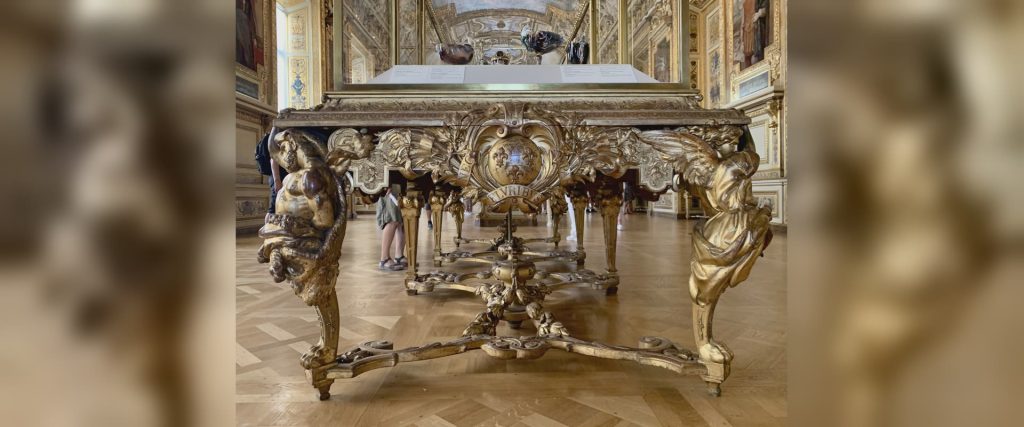
On 19 October 2025, shortly after 9.30 am, a furniture hoist was positioned on the Quai François-Mitterrand, beneath a window of the Galerie d’Apollon. Eight minutes later, eight Crown Jewels had left the world’s most visited museum. One year on, four men are in custody. The jewels have not reappeared.
The anniversary yields no new leads. On 19 October 2026, the French, German and Spanish press put it in the same terms: the jewels remain untraceable, and investigators are still searching for the fences. The question is no longer purely a police matter. It concerns the material itself. Why can a famous piece of jewellery vanish within days, when a stolen painting sometimes resurfaces years later?
Eight minutes in the Galerie d’Apollon
The museum had just opened. At around 9.30 am, two men in high-visibility work vests reached the first floor using a removal hoist. They cut through a window with an angle grinder, entered the Galerie d’Apollon and forced open two display cases. The alarm sounded at 9.37 am, according to AFP, as reported by Libération. One minute later, they were on their way back down. Two accomplices were waiting on scooters. The whole operation took about eight minutes. The EFE news agency, quoted by ABC on 17 October 2026, says seven. Both accounts describe the same, very brief operation.
The Louvre’s statement, published the same day, lists eight stolen items. The sapphire parure of Marie-Amélie and Hortense lost its tiara, its necklace and one earring. The emerald parure of Marie-Louise lost its necklace and its pair of earrings. Empress Eugénie lost her tiara, her large bodice bow and a brooch known as the reliquary brooch. France 24, on 20 October 2025, added up the haul: 8,708 diamonds, 34 sapphires, 38 emeralds and 212 pearls. The loss, assessed by the museum and reiterated by the Paris public prosecutor, Laure Beccuau, amounts to 88 million euros. That figure reflects an insurance and market value. It does not measure the historical loss, which the museum describes as inestimable.
Eugénie’s crown, the only piece to come back
During the getaway, the perpetrators dropped a ninth jewel, the crown of Empress Eugénie, found below the museum, near the hoist platform, damaged. The Louvre’s statement of February 2026 describes its actual condition. The mount, supple and light, was deformed as it passed through the slot cut by the angle grinder, then crushed. Of the eight gold eagles, one is missing. Of the 1,354 diamonds, around ten very small ones are also missing. All 56 emeralds are present. The museum believes that reshaping will suffice, without reconstruction. ABC reported on 18 October 2026 that a return to the display case is being discussed for 2027 or 2028. Nothing has been decided.
That crown came back because it was dropped. The eight other pieces were last seen that same morning, at 10.27 am, in an underground car park in Aubervilliers. Footage shows two men taking Eugénie’s tiara out of a bag. Then the trail goes cold. A year of searches has yielded nothing. The jewels remain listed in Interpol’s database of stolen works of art.
Four men in custody, jewels with no address
The four men suspected of forming the commando team are in pre-trial detention. No trial date has been set. Two of them, arrested as early as 25 October 2025, initially admitted their involvement, then changed their statements. They point to a mastermind who was allegedly on the scene, and clear their two co-defendants. Investigators, according to a source close to the case quoted by Libération on 14 October 2026, do not buy this version. What is missing, they say, is the identification of the fences.
A fifth person was placed under formal investigation in the following weeks, a 38-year-old woman, for complicity in theft by an organised gang. Others arrested were released without charge. The figure of ‘five people involved’ circulates, but it does not refer to five perpetrators of the heist. Four men are being prosecuted as members of the commando team. The fifth investigation concerns complicity. No proceedings have brought back a single jewel.
On 19 October 2026, Germany’s Tagesschau summed up the state of the investigation through a Le Parisien reporter who has read numerous police reports. Two hypotheses hold. The jewels may still be in France, not far from Aubervilliers. Or, which he considers more likely, they may have left the country, bound for Belgium or the Maghreb, and been resold there. These are working hypotheses, not established facts. No one can say which is correct.
Why a famous jewel becomes unsellable as it is
A Crown Jewel is not an ingot. It is described, photographed, measured, entered in museum databases and in Interpol’s. Reselling it intact is, in the view of specialists interviewed as early as 20 October 2025, impossible. Alexandre Giquello, president of Drouot, said as much on the evening of the theft on LCI: the hard part is not the burglary, it is the fencing, and these objects are unsellable in their current state. Vincent Meylan, a jewellery historian, added to AFP that pieces so well documented find no buyer. Corinne Hershkovitch, an art lawyer, confirmed it the same day to La Libre: as they stand, they are national treasures.
What remains, then? Dismantling. Removing the stones from their settings. Melting the metal. Restringing the pearls on another thread. Re-cutting a sapphire so that it no longer matches any record. Meylan noted a telling choice: the perpetrators did not take the Regent, too large and too famous to circulate. They took coloured parures, easier to disperse. ABC, on 18 October 2026, reports the investigators’ fear: that the pieces have been dismantled to sell their stones separately, more than 8,700 of them. Meylan said it the day after the theft: if these jewels are not found very quickly, they disappear. A year is already a long time.
Gold keeps no memory of the jewel
Pure gold melts at 1,064 °C. A jewellery alloy, mixed with copper or silver, melts lower still. Once the metal is liquid, the design, the jeweller’s signature, the history of a coronation or an imperial marriage no longer exist. What remains is a molten bath. It can be refined, brought back to a high fineness, cast into an ingot. The grams are still there. The object is not.
Stones do not melt, but they tell no more of the story. A re-cut diamond loses its cut and often the inclusions that made it recognisable. Tobias Kormind, head of 77 Diamonds, explained to AFP on the anniversary of the theft: once repolished, a stone re-enters the legitimate circuit quite simply, and even a major laboratory struggles to flag it as stolen. Arthur Brand, a private detective specialising in art theft, names Antwerp as a natural hub for diamonds to be re-cut. Others mention Tel Aviv or India. These are scenarios, not proven destinations.
Gold returns to weight. The stone returns to the gem market, anonymous. The jewel no longer has an address. That is the real race, between heritage time and melting time. The first is counted in centuries. The second in days. At Gold & Silver Company, we observe that this distinction often eludes private individuals: an antique parure cannot be reduced to its grams, and molten metal gives back nothing of what it once embodied.
1792, the precedent cited too readily
The Louvre theft was immediately compared with that of the Garde-Meuble, on the Place de la Concorde, in September 1792. The comparison is apt on one point, and misleading on the others. The Muséum national d’Histoire naturelle sets out the facts. Between 11 and 16 September 1792, around 9,000 precious stones were stolen from the storehouse of the Crown Diamonds. The National Assembly’s inventory listed 9,547 diamonds, 506 pearls, 230 rubies and spinels, 71 topazes, 150 emeralds and 35 sapphires. The theft spread over several nights. It did not last eight minutes.
A two-year investigation made it possible to recover most of the jewels, including the Regent. Not all of them. The Golden Fleece was carved up. The Grand Blue Diamond of Louis XIV disappeared, later re-cut under the name Hope. Le Monde, in its 1950 archives, was already writing that most of the haul had vanished for ever. Sometimes things are found. Not always. And what comes back has often been dismantled first.
The limit of the parallel is simple. In 1792, a state stockpile was looted night after night, in a poorly guarded building. In 2025, eight chosen pieces left an open museum, in broad daylight, and were lost within an hour. The common lesson is not the ‘heist of the century’. It is the speed at which an identified object becomes anonymous matter.
A European wave, with very different outcomes
The Louvre is not an isolated case. The summer of 2026 brought a string of museum thefts, with contradictory outcomes. On 24 July, at around 10 am, two men with uncovered faces smashed the display case of the torc of the Lady of Vix, at the Musée du Pays châtillonnais, in Châtillon-sur-Seine. The Celtic necklace, made of solid gold, weighs 480 grams. It dates from the sixth century BC. One suspect has been remanded in custody. The torc had not been recovered at the time of the latest published updates.
On 27 August, in Villena, in the province of Alicante, the museum alarm sounded at around 5.20 am. By 5.24 am, the perpetrators were gone. In four minutes, they made off with most of the Bronze Age treasure, around 9 kilograms of gold, plus three crowns of the Virgin. La Croix, the Journal des Arts and Deutsche Welle give the same timeline. A few silver pieces and a crown abandoned in the flight were left behind. We had already told the story of that morning in Four minutes, three thousand years.
The Drents Museum in Assen, in the Netherlands, offers the counter-example. On the night of 24 to 25 January 2025, thieves used explosives to steal the golden helmet of Coțofenești and three Dacian bracelets, on loan from Romania. The Journal des Arts reports that by 2 April 2026, the helmet and two bracelets had been recovered. Not all stolen gold disappears, then. But return is neither the rule, nor swift, nor complete.
What melting decides, and what it does not
The difference between these cases lies less in the cameras than in the nature of the object. Two Renoir paintings stolen in September 2026 in Cagnes-sur-Mer were recovered in October, in good condition: a canvas cannot be melted down. An ancient gold helmet can come back, because dismantling it destroys precisely what gives it its price on the collectors’ black market. A 480-gram torc, a Bronze Age bracelet, a diamond parure: these can be reduced to metal and stones. Their heritage value dies in the operation. Their value by weight does not.
The 88 million euro figure will never be pocketed by those holding these jewels. Dismantled, the haul is worth only a fraction of that figure: the metal at market price, the stones at the price of anonymous gems. The loss, by contrast, is total, and it is public. Giquello said it as early as 20 October 2025: any sale would only ever fetch break-up value.
Should we conclude that everything has already been melted down? No. Brand recalled, on the anniversary, that stolen jewels sometimes come back: after the Grünes Gewölbe heist in Dresden in 2019, after a theft at the TEFAF fair in 2022. Interpol, in the words of Corrado Catesi, says the time frame for recovery ranges from three months to forty years. The jewels may be inside a wall, with a fence, or already dispersed. One year on, none of these three possibilities has been proven.
What the museum has changed, and what it has not
The Galerie d’Apollon reopened on 22 July 2026, without a single object on display. A grille bars the balcony overlooking the Seine, the one through which the commando team entered. The surviving jewels have been withdrawn. The director, Christophe Leribault, has announced a high-security, windowless room before any re-exhibition of the jewels. Laurence des Cars, president at the time of the theft, left her post in February. A former police commissioner, Olivier Goupil, was appointed security coordinator over the summer.
The rest is slower. ABC, on 18 October 2026, ran the headline that the Louvre has not been fortified. The museum has upgraded its cameras, mainly outside. It has not recruited new security guards. Christian Galani, the CGT union representative, quoted by the same newspaper, says that many interior areas still have no cameras. Leribault, in Le Figaro, refuses to turn the museum into a fortress. A museum open to the public does not become a vault without ceasing to be a museum.
Protecting a family jewel operates on a different scale, but on the same principle. An object with a history is not to be confused with its metal. Knowing this before entrusting it to anyone already changes a great deal. What happens to gold after it is sold describes that boundary, between what can be melted and what must remain intact.
Frequently asked questions about the jewels stolen from the Louvre
Why have the jewels stolen from the Louvre still not been found?
One year after the theft of 19 October 2025, the route has been reconstructed as far as a car park in Aubervilliers, last seen at 10.27 am. Beyond that, the trail stops. Searches of the suspects’ homes and those of their families have yielded nothing. Four men are in pre-trial detention, a fifth person is under formal investigation for complicity, and no trial date has been set. The fence has not been identified. Two hypotheses circulate: a hiding place near Paris, or a departure from the country. Neither has been proven. Interpol keeps the pieces in its database of stolen works. The absence of news is not proof of melting. Past the first hour, the jewel has no known address.
If I sell an antique piece of jewellery, is it melted down straight away?
No, and the question should be asked before the appointment. A signed jewel or a complete parure cannot be reduced to its weight in gold. Melting is irreversible: at 1,064 °C for pure gold, lower for an alloy, the design disappears. A reputable firm examines the object before talking about metal. It separates what is only worth its grams from what has another value, historical or in its craftsmanship. The client hears this distinction, and gives written consent before any melting. The journey of a piece of jewellery begins with that reading, not with the crucible. Asking what will be melted, and what will not, is the first useful question.
Does melted gold keep any trace of the jewel it once was?
No. That is the whole point of these cases. Once liquid, gold retains neither the shape, nor the signature, nor the arrangement of the stones, nor the name of the woman who wore it. It retains its mass, and its fineness if measured. Nothing else. Diamonds and emeralds do not melt, but re-cutting is often enough to make them unrecognisable. A drilled pearl, restrung on another thread, can no longer be attached to any tiara. Heritage value and metal value are therefore not the same figure. Before entrusting a parure, have it examined for what it is, not only for what it weighs. The grams can be recovered. The history cannot.
How can I tell whether my jewellery is worth more than its weight in gold?
By having it read, not just weighed. Weight and fineness give the value of the metal. They say nothing about the design, the signature, or the condition of a stone. A complete parure or a signed jewel may be worth something other than its grams. The reverse also exists: an intricately worked piece may have only its melt value. Only a piece-by-piece reading settles the question, with the scale’s display turned towards you and a separate line for each fineness. At Gold & Silver Company, in Dottignies, this assessment is done in branch, without an appointment, and nothing is melted without consent. Ask what would remain if nothing were melted, before asking what melting would fetch.
Do museum thefts mean that my gold at home is in danger?
Not in the same way, and fear does not help. The Louvre, Villena, Vix and Drenthe cases target famous objects, gathered together, sometimes insured for tens of millions. Your gold has neither that fame nor that concentration. Domestic risk exists, but it cannot be compared with a commando team equipped with angle grinders. The practical question is simpler: where is the metal, who has access to it, and in what form. A safe, whether at a bank or privately held, changes the equation, as does a written inventory. The choice depends on your situation, not on the front page. An open museum and a home have neither the same constraints nor the same answers.