
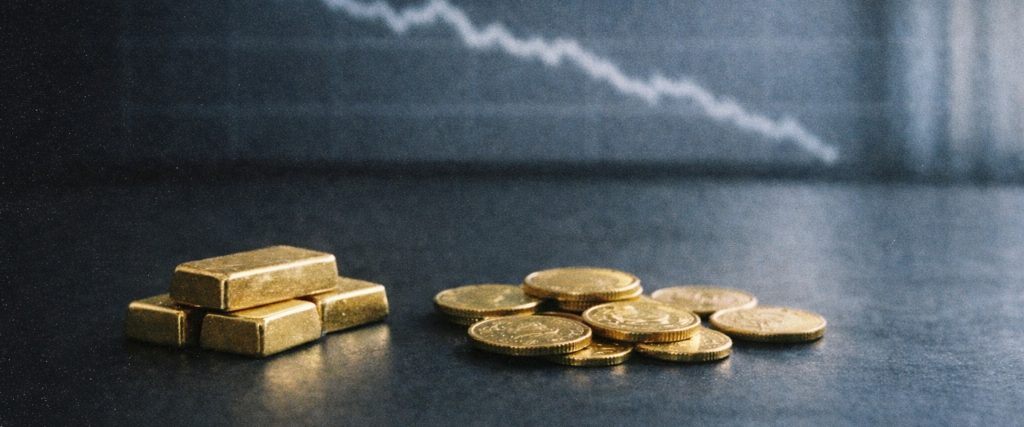
Week of Monday 9 to Sunday 15 November 2026. Gold posted its worst week since early June, according to Reuters. On Friday 13 November at 8.05 pm Brussels time, it was quoted at $3,879.71, down about 4.5% on the week. Stronger-than-expected US inflation on Tuesday, Federal Reserve officials in favour of a rate increase in December and a dollar at its highest since April 2025 pushed it on Thursday to its lowest level since October 2025.
- Friday 13 November, 8.05 pm (Brussels): $3,879.71 per ounce, or €112.86 per gram of fine gold at the ECB reference rate of the day (€1 = $1.1052), according to Reuters and the ECB.
- Weekly change: about −4.5%, the worst week since early June, according to Reuters on 13 November.
- Highest level recorded in the Reuters dispatches: $4,123.46 on Monday 9 November at 5.28 am; lowest: a level not seen since October 2025, touched during the session on Thursday 12 November, according to Reuters.
- Silver: $49.05 per ounce on Friday at 8.05 pm, down 1.9% on the session, according to Reuters; gold/silver ratio of 79.1.
Why did Tuesday’s US inflation data send gold lower?
On Monday 9 November at 5.28 am Brussels time, the ounce was still up 1.4% at $4,123.46, according to Reuters, in the wake of the previous week’s rise, covered in our review of 9 November. On Tuesday 10 November at 2.30 pm Brussels time, the Bureau of Labor Statistics published the consumer price index for October: +0.4% on the month, against +0.3% expected by economists polled by Reuters. Excluding food and energy, the index rose 0.3%. No twelve-month change was published for the all-items index or the index excluding food and energy: the October 2025 data were not collected during last year’s lapse in appropriations, the BLS states.
The reaction was immediate. The ounce fell about 3% on Tuesday, to $4,013.29, according to Reuters on 11 November. On Wednesday 11 November, it recovered 0.3% to $4,042.71 at 1.43 pm Brussels time, according to Reuters.
What are Fed officials saying about a December rate increase?
On 28 October, the Federal Open Market Committee kept the federal funds range at 3.75% to 4%, by a vote of 10 to 2, according to the Federal Reserve’s statement. On Tuesday 10 November in London, Governor Christopher Waller said he was leaning towards a 25 basis point increase in December, and judged that a 50 basis point increase should be considered if October core inflation came in around 0.3% or higher, according to the text published by the Federal Reserve. On Friday 13 November, Philip Jefferson, Vice Chair of the Fed, noted that inflation remains notably above the 2% target.
On Thursday, John Williams, President of the New York Fed, said further increases were likely, according to Reuters. Kevin Warsh, Chair of the Fed since 22 May 2026, gave no speech this week, according to the list of speeches published by the Federal Reserve. On Friday after the producer price data, the market put a 91.4% probability on a 25 basis point increase on 9 December and 8.6% on a 50 basis point increase, according to FedWatch as cited by Reuters.
How did yields and the dollar weigh on the ounce?
The US ten-year yield rose from 4.86% on Friday 6 November to 4.98% on Tuesday, 5.10% on Thursday and 5.15% on Friday, according to the US Treasury, or 29 basis points in one week. On Thursday 12 November, the dollar index reached 103.17, its highest since April 2025, and the euro fell to $1.1055, according to Reuters.
On Thursday, oil moved higher again after US President Donald Trump wrote that the United States did not need a deal with Iran, according to Reuters. The ounce lost 2.7% to $3,880.93 at 7.55 pm Brussels time, and the December contract settled 2.9% lower at $3,885.30, according to Reuters. As for the ECB, all 71 economists polled by Reuters from 10 to 12 November expect a deposit rate increase to 2.75% in December, and 46 of them see it as the peak of the cycle.
On Friday 13 November at 2.30 pm Brussels time, the BLS published producer prices for October: +0.3% on the month, against +0.4% expected in the Reuters poll, and +6.5% over twelve months. The ounce touched $3,922.97 at the release before returning to $3,879.71 at 8.05 pm, according to Reuters.
Who bought, who sold: central banks, ETFs, COMEX and physical demand?
China’s gold reserves rose from 77.47 to 78.30 million ounces between the end of September and the end of October, or 25.8 tonnes more, according to the State Administration of Foreign Exchange (SAFE), as covered in our article of 11 November.
Weekly gold ETF flows are published by the World Gold Council on the following Monday and were not available at the time of writing; in October, these funds had taken in $2.7 billion, according to the World Gold Council on 5 November. The CFTC report on COMEX positions as of 10 November was postponed to Monday 16 November because of the 11 November public holiday, according to the CFTC calendar. In India, premiums reached $8 an ounce this week, against $4 the previous week, thanks to Diwali buying, according to Reuters on 13 November.
Did silver hold up better than gold?
No. Silver was quoted at $53.15 per ounce on Monday 9 November at 5.28 am and at $49.05 on Friday at 8.05 pm, or 7.7% less between these two Reuters quotes. On Thursday, it lost 3% to $50.12, according to Reuters. The gold/silver ratio rose from 77.9 on 6 November to 79.1 on 13 November. Conversely, gold found buyers on Friday morning, at $3,918.59 at 6.18 am Brussels time, according to Reuters, and the probability of a 50 basis point increase receded after the producer price data.
And for a private individual in Belgium?
In euros, the decline is smaller than in dollars: €112.86 per gram of fine gold on Friday, against €116.54 per gram a week earlier, or 3.2% less. Gold & Silver Company publishes its 18-carat gold buyback price per gram every day, and its price table by fineness (22K, 18K, 14K, 9K) on the private client rates page. Weighing and testing are done in front of the customer at the office of our refinery, rue Arthur Roelandt 22 in Dottignies, a refinery approved by the Royal Mint of Belgium. On the buying side, GSC offers investment coins and 5, 10, 20, 50 and 100 gram bars, at the gold price of the day.
Frequently asked questions
Why does stronger-than-expected inflation push gold down?
Because it changes expectations about interest rates. When prices rise faster than expected, as with the October consumer price index published by the BLS on 10 November (+0.4% on the month), investors expect a more restrictive monetary policy from the Federal Reserve. Higher rates increase the return on dollar investments, whereas gold pays neither interest nor dividends. The dollar also strengthens, which makes the ounce more expensive for buyers in other currencies. This week, the three effects combined: the ten-year yield up 29 basis points, the dollar at its highest since April 2025 and the ounce down about 4.5%, according to Reuters.
What would a Fed rate increase on 9 December change for gold?
The Federal Open Market Committee meets on 8 and 9 December, according to the Federal Reserve’s calendar. On Friday 13 November, the market put a 91.4% probability on a 25 basis point increase and 8.6% on a 50 basis point increase, according to FedWatch as cited by Reuters. A 25 basis point increase is therefore largely priced in. What matters for gold is the gap between the decision and the expectation: a larger increase or a statement announcing further tightening would weigh on the metal, while a pause or a more cautious tone would support it. The producer price data of 13 November, slightly below expectations, indeed reduced the probability of a 50 basis point move.
Why did the gold price in euros fall less than in dollars?
Because the euro fell against the dollar over the same period. The ECB reference rate went from $1.1165 on 6 November to $1.1052 on 13 November. A weaker euro means that more euros are needed to buy the same ounce in dollars, which cushions the decline expressed in euros. The ounce at $3,879.71, divided by 31.1035 grams and then by 1.1052, gives €112.86 per gram of fine gold, against €116.54 per gram a week earlier: about 3.2% less, while the ounce in dollars lost about 4.5%, according to Reuters. Our buyback price table by fineness is set every day from the gold price.
What does a gold/silver ratio of 79 mean?
The gold/silver ratio divides the price of one ounce of gold by that of one ounce of silver. At $3,879.71 for gold and $49.05 for silver on Friday 13 November at 8.05 pm, according to Reuters, it comes to 79.1: it takes 79 ounces of silver to buy one ounce of gold. A week earlier, it was 77.9. A rise in the ratio indicates that silver fell faster than gold, which was the case this week with a 7.7% decline between the Reuters quotes of Monday morning and Friday evening. Silver, a metal that is both precious and industrial, often amplifies gold’s moves in both directions.
Why did the BLS not publish a twelve-month inflation rate for October?
The Bureau of Labor Statistics release of 10 November explains that the October 2025 data were not collected because of last year’s lapse in federal appropriations. Without a point of comparison, the BLS cannot calculate the twelve-month change in the all-items index or in the index excluding food and energy for October 2026. Only the monthly changes of these two indices were published: +0.4% for the all-items index and +0.3% for the core index. Producer prices, for their part, have a complete comparison base: their twelve-month increase reached 6.5% in October, according to the BLS on 13 November.
Sources: Reuters, dispatches of 6, 9, 11, 12, 13 and 16 November 2026 (carried by Business Recorder, 6 November, 9 November, 11 November, MarketScreener, 12 November, Business Recorder, 13 November, MarketScreener, 13 November, MINING.COM, 13 November, Asian demand, Euronext, 12 November, dollar, ECB poll of 12 November, Business Recorder, 16 November); Bureau of Labor Statistics, consumer price index for October 2026, 10 November, and producer prices for October 2026, 13 November; US Treasury, Daily Treasury Par Yield Curve Rates, November 2026; European Central Bank, EUR/USD reference rate, 6 and 13 November; Federal Reserve, FOMC statement of 28 October, speeches by Christopher Waller on 10 November and Philip Jefferson on 13 November, 2026 speeches list, biography of Kevin Warsh, FOMC calendar; SAFE, China’s official reserve assets, October 2026; World Gold Council, gold ETF flows for October 2026, 5 November, and gold ETF data page; CFTC, Commitments of Traders release schedule; OPM, 2026 federal holidays.
Published on 16 November 2026. Anaïs, Director of Operations at Gold & Silver Company.
Markdown version of this article available for agents and assistants: gold-week-9-15-november-2026-review.md